Tuesday, 30 October 2012

Patchwork tales at Moulin Hall


Claire Hewitt and I were at Moulin Hall on Friday with the patchwork quilt for Tell a Story Day and for an event that was part of the Luminate Creative Ageing festival.  Children from four of Highland Perthshire schools came early to hear and rehearse ‘The Spider that Spun the Golden Web’, a wonder tale created on Claire’s Travelling Tales cycling project in May.  The children worked hard to learn the story.  There was no reading and no props. They just had their memories and voices to tell the story.  And they did, wonderfully well, to an audience in the afternoon of older people who had come to listen and to tell their stories about the patchwork quilt.
Some of those quilt stories were remarkable.  Angus Macmaster and his brother Archie came along and told us about their three aunts, Gracie, Katie and Bella Macmaster.  The three girls lived at Saunich, four miles over the hill from Kinloch Rannoch and they walked to and from school every day.  They were known as the ‘wild deer of Rannoch’. Even for the time that was a tough walk.  They all emigrated to Canada about a hundred years ago.  Perhapsthat wasn’t such a daunting journey for young women who’d walked the hills since they were five years old. Mabel Macaulay came from Kyle to talk about her grandmother, who was the assistant teacher in Lochmaddy when she signed her name on the quilt. Mabel had a school tale too. She lived on Kirkibost, a tidal island off North Uist, and went by boat or horse and cart, depending on the tide.
We are hoping to have more gatherings to hear stories from those patchwork names and, eventually, I will write them.  The patchwork names represent girls from three Highland and Island communities and their lives in those landscapes one hundred and odd years ago.  It’ll take some time to piece their stories and how they fit in their communities and landscapes, so it will be a while.  And hopefully we can get some funding.  In the meantime the stories on Friday were wonderful to hear, and thank you to all who came to listen and tell. It was a very special day.

Wednesday, 10 October 2012

Pop Up Prints

Buoyed up by another successful outing at Fortingall Art the Splinter Group is branching out again. We are going to be in a ‘pop-up shop’ in Dunkeld for three weeks between the 10th and 27th October.

We will be in Zigzag, next to Palmerstons Café. Zigzag was a lovely little shop where Dave Amos sold mostly locally produced handmade goods. He used to sell some of my stuff too, mostly beads and felt from my early craft selling days. Dave has gone on to other things but for three weeks only we'll be stepping in to fill the shop before the new tenants come in.  We’ll be mostly selling prints in our three week stint, though Penny Kennedy has her new home-ware and wrapping papers for sale under her new ‘Homebird’ brand. Linda Farquharson has lots of her exquisite lino prints, and I’ve put in a few too. And of course there’s the range of Splinter output, especially the Animal Alphabet and this year’s Calendar project. There’s also some Philip Wood pots, handmade notebooks and wood carvings.

I went along at the weekend to help Penny and Linda set up and was impressed how good it looked even before we’d got it fully setup.

Tuesday, 2 October 2012

Patchwork Stories, Patchwork Names


To mark National Tell a Story Day, Claire Hewitt and I will spend the afternoon at Moulin Hall, Pitlochry on Friday 26th October with the patchwork and some of its stories.  Local schoolchildren will also tell their new wonder tale ‘The Spider that Spun the Golden Web’ created on Claire’s ‘Story Cycle’ this summer. 
We hope a few people with connections to the girls on the patchwork will come along and tell their stories over a cuppa and cake. 


The event is part of The Luminate Festival and The Scottish International Storytelling Festival.

Names on the quilt
The dates when Isabella Christie taught at each school and the relevant names are listed below.  The information comes from the census: 1881 for Heisker, 1891 for Lochmaddy and 1891 and 1901 for Kinloch Rannoch.  Sisters are together under one surname, names in full are for girls from different households.  Clearly there aren’t that many surnames (or first names for that matter), especially in Heisker and Lochmaddy. A few girls signed just with initials and, because I think they will be almost impossible to trace, I've missed them out.

Heisker, 1882 to 1887: Chrissie and Annie Macaulay, Maggie Macaulay, Effie Macaulay, Jessie and  Annie (Jannet) McCuish, Alexandrina Macdonald, Chrissie and Lizzie Macdonald, Maggie Macdonald, Maggie and Marian Morrison, Marion Morrison.

There is a second Chrissie Macaulay who I think was from Heisker, but I can’t be sure.  Katie Morrison, is listed in the relevant census for Heisker and Lochmaddy in two different families, so I don’t know which she belongs to.

Lochmaddy, 1887 to 1894: Bella Dingwall, Anna and Effie Dingwall, Maggie and Bessie Grant, Katie McDiarmid, Jeanie Macdonald, Bella Macdonald,  Shenac (Jean) Macdonald, Effie Macdonald, Mary Macdougald, Bessie McFarlane, Rachel Macgilp, Rachel and Marian Mcinnes, Lizzie Mackay, Flora and  Isabel Maclean, Maggie and Annie Macorquodale, Chrissie Morrison, Chrissie Kate Stewart.

Kinloch Rannoch, 1895 to 1897: Catherine Anderson, Euphemia Cameron McGregor, Jessie Campbell, Lizzie Dewar, Maggie Farquharson, Tina Forbes, Annie Fraser Stewart, Christina McEwen, Jeannie MacMartin, Katie, Bella and Gracie MacMaster, Maria Macpherson, Flora and Maggie MacSwan, Mary Munro,  Maggie Richardson, Bessie Robertson, Marie, Katie and Jessie Scott, Annie Sinclair, Mary Templeton, Maggie Thomson, Jessie Urquhart.

The following names weren’t located, though, given that the census for Heisker and Lochmaddy are a good match and most of them have surnames that were not found in the islands (apart from McCuish, Macdonald and possibly Macdougald), it’s likely they’re mostly from Kinloch Rannoch.

Maggie Clark Macdonald, Maggie Cooper, Katie Cramb, Mary Cramb, Isa Dott, Bessie Ferguson, Chrissie Macdougald, Bella McCuish, Annie McIntosh, Ethel Mackenzie, Madge Mackenzie, Barbara McColl McInnes, Jessie Maconie McInnes, Jeannie McPherson (twice), Katie McPherson, Elsie Stuart, Williamina Sutherland, Gracie Thomson, Maggie Todd Robertson, Tina Bell Turner Campbell.

The spelling of surnames is more or less standardised but the first names are as they appear on the quilt.  There’s a bit of guessing about which first name matches with the census records. Where there are different first names but it seems a plausible match the census recorded name is given in brackets.

Tuesday, 18 September 2012

Taking a closer look at two master wood engravers


The Splinter Group had an outing on Friday, to see the exhibition of wood engravings by Eric Ravilious at Aberdeen Art Gallery.   We also were shown their collection of work by Claire Leighton, another consummate wood engraver who worked in the 1930s. 
Ravilious’ work was typical Ravilious, decorative, full of mark making, playful.  There was a strong sense of him testing out his tools to see what marks they could make, and the way he played with perspective gave his work a naïve feeling which I guess is reflected in the work of many designers and illustrators today.  Leighton on the other hand was more about the subject.  The Gallery’s collection was mostly from a series she did based on workmen in the US.  To me, the most successful were of men in snow, shovelling in the streets of New York or a wagon hauling through the backwoods.  The snow helped lighten the blacks, which dominated her images. Her work was all about outline and shape, beautifully athletic men and machinery in rugged landscapes.  Tone was minimal and just a few strokes of her spitsticker were all she used to relieve the black.  There’s a hint of that socialist worker stuff that was fashionable then in art but certainly not now.  Unlike Ravilious, whose decorative, not-quite-but-almost quaint, certainly charming, Englishness is still popular. Robert MacFarlane devotes a chapter to him in The Old Ways, so he must be in.

Not all Claire Leighton’s work was so dark, she wrote and illustrated a lovely book about her garden, Four Hedges, which was reissued in 1970 so not outrageously expensive on Abebooks.
Plenty of inspiration for the next Splinter project…..

Monday, 10 September 2012

Reconnections


Borenich is a tiny graveyard perched on a knoll and with views to Schiehallion a few miles west and Loch Tummel, just to the north.  There are only two gravestones and a little iron cross, though there are some recumbent stones. I couldn’t get the gate open so I didn’t go in, but I could read the gravestones, both with Stewart names engraved on them.  I went to visit after meeting Cathy Laing, who was born a Stewart, told me about the place on North Uist at the patchwork quilt meeting at Taigh Chearsabhaigh. Chrissie Kate Stewart, Cathy’s grandmother, signed her name on the quilt and her family, who were travellers, had strong connections with Borenich.  Isabella Christie taught down the road in Kinloch Rannoch and in Lochmaddy, at first sight completely unlinked places but it seems not.  There is a website about Borenich with lots of information about the people who lived there in the nineteenth century, when it was a reasonable sized village (www.borenich.co.uk).  Now there’s one farm, many piles of stones in the surrounding fields, a graveyard with a visitors’ book and the feeling that this place was connected in ways now long forgotten. 

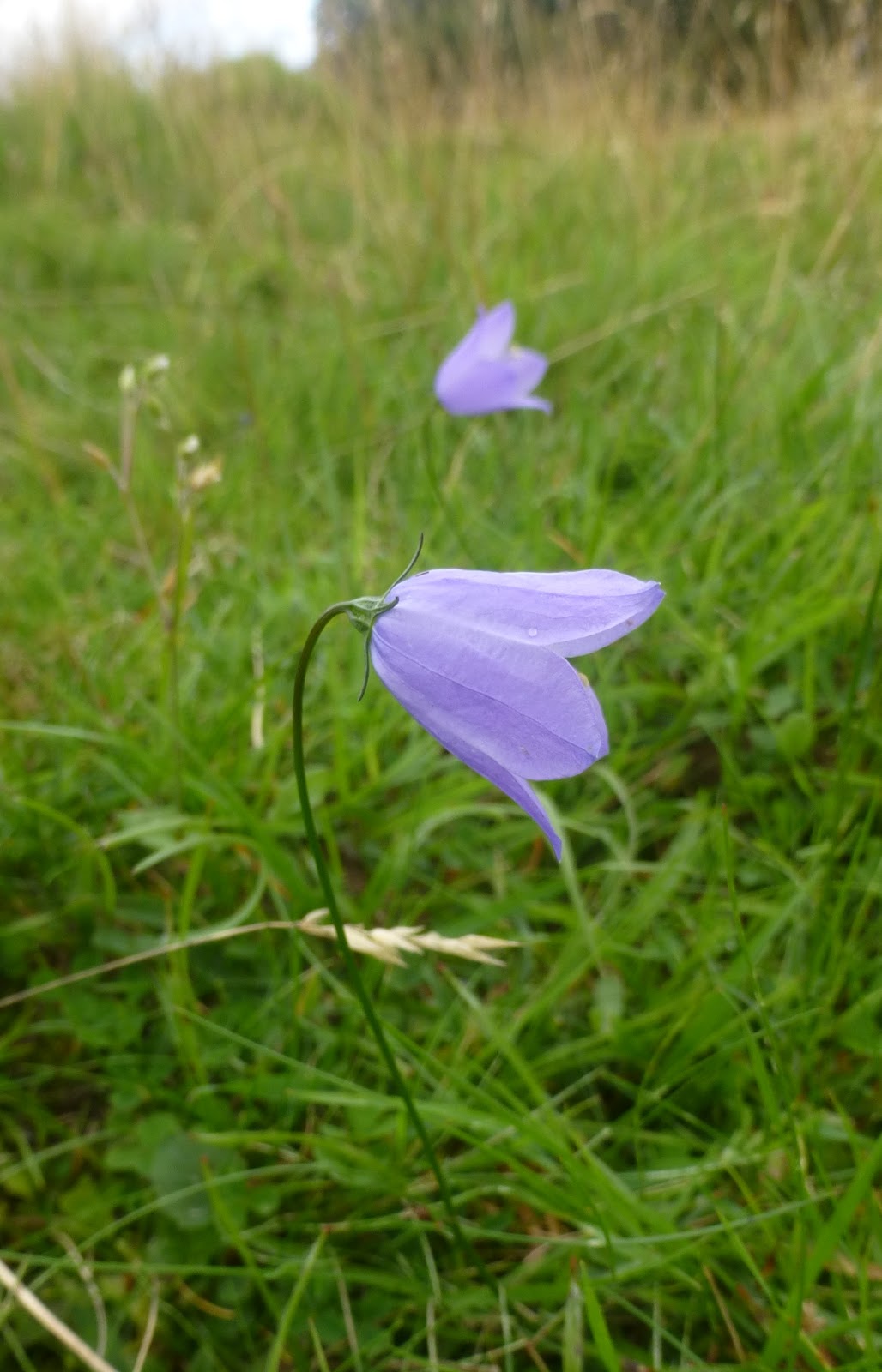
Mistle thrushes were feeding on the anthills in the dry grassland where these harebells were still in flower, just. 

Friday, 24 August 2012

A homecoming for the patchwork quilt


I went to North Uist at the weekend with Claire Hewitt taking the school patchwork back to one of its original locations in Lochmaddy.  The local heritage society had helped gather interested people to come to Taigh Chearsabhaigh, an arts and heritage centre, and see the quilt, hear some of what we already knew about it and to see the names.  Powerful things those names, they recorded grannies and great aunts for a surprising number of the people in the room.  Just about everyone was related to someone on the quilt, including children from Lochmaddy primary school. It was very moving to hear about the lives of those women and even to see photographs of some of them. We heard about a lost way of life too from Angus 'Moy' MacDonald, who had lived on Heisker until 1942, sixty years after Isabella Christie taught there and started making her quilt.  Those islands are uninhabited now.  The quilt holds many stories of loss and abandonment, but the people in that room also showed how it records continuity too.  It was an inspiring day.  We are hoping that the heritage society, and others, will help us gather memories and memorabilia together for an exhibition sometime with the quilt at its centre.

We camped at Balranald while we were on North Uist and I took the chance to explore the machair and take a closer look at the wildlife.  The flowers were past their best but there were still plenty around for insects, including some wind-tattered butterflies.  This bumblebee was a bit more robust and not quite so battered looking.  It's a Great Yellow, Bombus distinguendus, a species like the corncrake that has found a refuge on the Outer Isles from the intensive agriculture in the rest of the country that has driven it extinct elsewhere. It's not just people who keep their roots in these islands, the wildlife does too.


Thursday, 9 August 2012

Chasing butterflies

I was at Treswell last week and spent a couple of mornings chasing butterflies, trying to take photographs.  It's a bit of a zen pursuit.  I know I will get one eventually but it can take some time.  It's very meditative in its way.  This small skipper was relatively easy to catch compared to the gatekeepers and meadow brown that were also feeding on the knapweed amongst the long grass of the field that edges the wood.  The field is like a chunk bitten out of the wood (an asart I think, taken from the wood in medieval times, at least). It has a great view of the nearby Cottam power station, belching CO2 into the morning sky.  Notts Wildlife Trust are hoping to buy it and incorporate the field into the nature reserve. Judging from the butterflies it's already a valuable habitat.  Grassland that hasn't been fertilised, cut and reseeded into relatively sterile uniformity is increasingly rare, so I hope the Trust do manage to get it.