Tuesday, 17 January 2012
New Blog

Monday, 16 January 2012
Bogs and Puritans

I first heard the name Humberhead Levels in Catherine Caufield’s little book Thorne Moors, beautifully and starkly illustrated with photos by Fay Godwin, about the battle to save Thorne and Hatfield Moors in the 1980s and early 1990s when they were being destroyed by peat extraction on an industrial scale. They are raised bogs, great lenses of water held above the surrounding land in peat formed from millenia’s worth of bog mosses and cotton sedge. Bog in lowland England is a rare habitat, especially species-rich raised bogs like these. There's lots more about it at http://www.thmcf.org/. Thorne and Hatfield Moors became part of the Humberhead Peatlands National Nature Reserve in 1995 but, incredibly, peat extraction didn’t stop until 2002. Now it has, English Nature and its partners are trying to get them back as healthy raised bogs. They’re getting there but there’s a long way to go. It was a shock to see bare peat stretching to the horizon.

The Humberhead Levels were splashy, isolated and independent until the Dutch engineer Cornelius Vermuyden started his massive drainage works in the seventeenth century. The locals rioted frequently after the drainage started, not surprising since it led to villages flooding, and the farming of land they’d previously hunted and fished was an imposition by foreigners and big landowners. It was also a place of religious independence. Charles and John Wesley, founders of Methodism, came from the island village of Epworth and several of the Pilgrim Fathers came from villages to the north of Retford. And Robin Hood was said to hunt on Hatfield Chase: an odd sort of place that gave birth to outlaws and Puritans. We ended our day at Crowle, where we passed the time of day with a man pushing an old bike and balancing a bag of wood gathered from the moors. It was a perfect conversation of its sort. He thought through every word he said, and every one was a gem. Maybe there was something about the place that gave time and space for thinking for yourself.
Friday, 6 January 2012
Treswell Wood

I’ve been working with my brother, Rob, to produce a book about Treswell wood just a few miles from where we grew up in Retford, North Nottinghamshire. Rob works for the Notts Wildlife Trust, who own the wood, and he manages it on their behalf. At first sight it doesn’t seem all that special. Although it’s an ancient wood there aren’t many old trees since it was felled in the war and then sold on to a forestry company who wanted to plant it with conifers. It was rescued from that fate by the Wildlife Trust nearly 40 years ago and they tried to get some coppice going again but it didn’t have much long term impact. In those days nature conservation was about preservation and change was suspect. Ideas in the field have moved on and it’s started to be recognised that nature is remarkably dynamic and resilient, if it’s allowed to be.
In the mid 1990s the pace of change at Treswell stepped up when a Rob and a group of like-minded people started to try and make a living from coppicing. Coppicing is all about change, taking out canopy trees for timber and to let in light, cutting hazel shrubs regularly to get a range of useful habitats and lots of lovely sticks. It can look like tidying up, housekeeping transferred to the woods, but the tidiness doesn’t last and wildness quickly returns. Generally a tidy countryside is bad for wildlife but coppicing is unusual in that it creates a range of habitats that can be used by all sorts of plants and creatures. A well coppiced wood should be a healthy wood.
Treswell has been quite intensively managed for getting on for twenty years now by a small army of professional woodsmen and volunteers who are helping turn it back to healthy coppice that provides a range of valuable products and habitats. It’s the people that make Treswell unique. Although the wood is owned by a conservation organisation whose priority is its wildlife, it is treasured by many people who value it in many different ways. The book will focus on those people and hopefully will provide inspiration and ideas for anyone who is interested in ecologically and economically healthy woodland.
And as Christmas present for Rob I had my first go at woodcut printing. This is the result, inspired by Treswell. I’ll write more on woodcuts another time.
Monday, 2 January 2012
Deep in the dark of Adana

I’ve just made my first attempt at letterpress printing. I wanted to make a Christmas card that combined words and wood engraving so I wrote a short poem, engraved a block to illustrate it and then wondered how I was going to print it. I thought, briefly, about using a computer, scanning the image and placing the text around it but I was dubious how the wood engraving might scan, my printer is unpredictable and I struggled to use a page setup programme that would place the text exactly where I wanted it. So I decided to send a winter card instead and waited until after Christmas when I could visit a friend who has an Adana press and lots of type and had a go at printing it by hand.
The Adana press is a small, portable press that could quickly and relatively easily be used to print flyers and cards. I like to imagine it was a gift to radical groups in the 1960s and 1970s who wanted a cheap way of printing revolutionary text without having to go to professional printers, though it was probably used more by the professionals for printing business cards for the bourgeoisie. Sadly it’s no longer in production, though there’s a good market for them on eBay and you can buy them reconditioned (www.caslon.co.uk).It was a fiddly, time consuming, but deeply satisfying in-
a-way-computers-never-can

-be, process to print. I suspect it was a bit ambitious to make a first attempt combining letters with a wood block, especially since it was quite a big block, but I was reasonably happy with the result. We tried printing just the block first and managed to get a print that showed all the detail of the engraving but when I added the type the first print was just text and no image. That was because the wood block was lower than the type and it took several hours of absorbing work to get the type and the block to the same height and absolutely level. I didn’t get it perfect but it was good enough. I ended up with too much ink so the fine detail of the wood engraving got lost and the letters were a bit blurry, but not bad for a first attempt.
The words on the print came from the first line of my winter poem:
Deep in the dark of the wood
When ice crystals starred the night
A spruce in her skirts stood
Tall as if reaching full height
And way in the north Aurora
Soared to the zenith above
And a fox and a hare
Caught the light as if it were love.

Happy New Year
Monday, 22 August 2011
A real market, not a supermarket

 of stalls but there’s also live music, an outdoor cafe and even a wee train that can take you on a gentle chug around the farm for a couple of quid. It’s become a regular part of my life. I go to shop: there’s great bread on sale, superb chocolate, plenty of meat, including wild game, fish, veg, cakes, locally roasted coffee, plants, bric-a-brac and all sorts of crafty things. But I also go to meet up with people and do some small bits of business. So this month I was helping to publicise the new season of our local film society, sold some of the stuff I’ve been clearing out my house, did my weekly shop, met up with friends and made various social and work arrangements. Even Todd, my dog, had a good time and met up with plenty of doggy friends.
 supermarket. It’s what markets should be about, local makers and producers selling direct, a local farm doing their best to diversify and a valuable gathering place for people from Aberfeldy, Dunkeld, Pitlochry, all the places between and a good few from further afield too. It’s made a real difference to Highland Perthshire where there is a real struggle to maintain a sense of community in an area with a small and dispersed population. It’s great to see a living version of the ancient markets that dotted the human landscape around here for so many centuries. Long may it prosper!
Tuesday, 16 August 2011
Weeds

There is an ecological definition of a weed, which is a plant that can take off quickly in disturbed ground, flower, fruit, set seed and spread further into more disturbed ground. And gardening is all about disturbance, digging and spraying especially are a gift to weeds. Inevitably weeds are a gardener’s lot, but you can do a couple of things to reduce the stress of it, one is to not spend all your time disturbing things, the other is to learn which are a problem and which are actually quite attractive if you take the time to notice.
I find weeds a bit more worrying outside of the garden. There are the monster weeds, giant hogweed, Japanese knotweed and Himalayan balsam spring to mind, especially on rivers. There’s not much of the hogweed or japweed around here, on the upper reaches of the Tay, but there’s plenty of balsam, and it seems to be increasing pretty rapidly. This lot is on the Aberfeldy golf course. There was a lot less of it here until a few years ago when the groundsmen starting hacking the natural vegetation with a bit too much enthusiasm.

It helps if you know what a weed looks like too. Earlier this summer I saw a local farmer spraying herbicide along the river path. I think he was trying to kill off a patch of giant hogweed, but he managed to kill a good bit of sweet cicely and turned the butterbur in terrible contortions. It’s not surprising the biodiversity of this country is in such a terrible state (there's a thorough account in Silent Summer, ed. Norman Maclean, depressing stuff) when a farmer doesn’t know his sweet cicely from his giant hogweed, or doesn’t bother to know.
Wednesday, 3 August 2011
Splinter Group at Fortingall Art
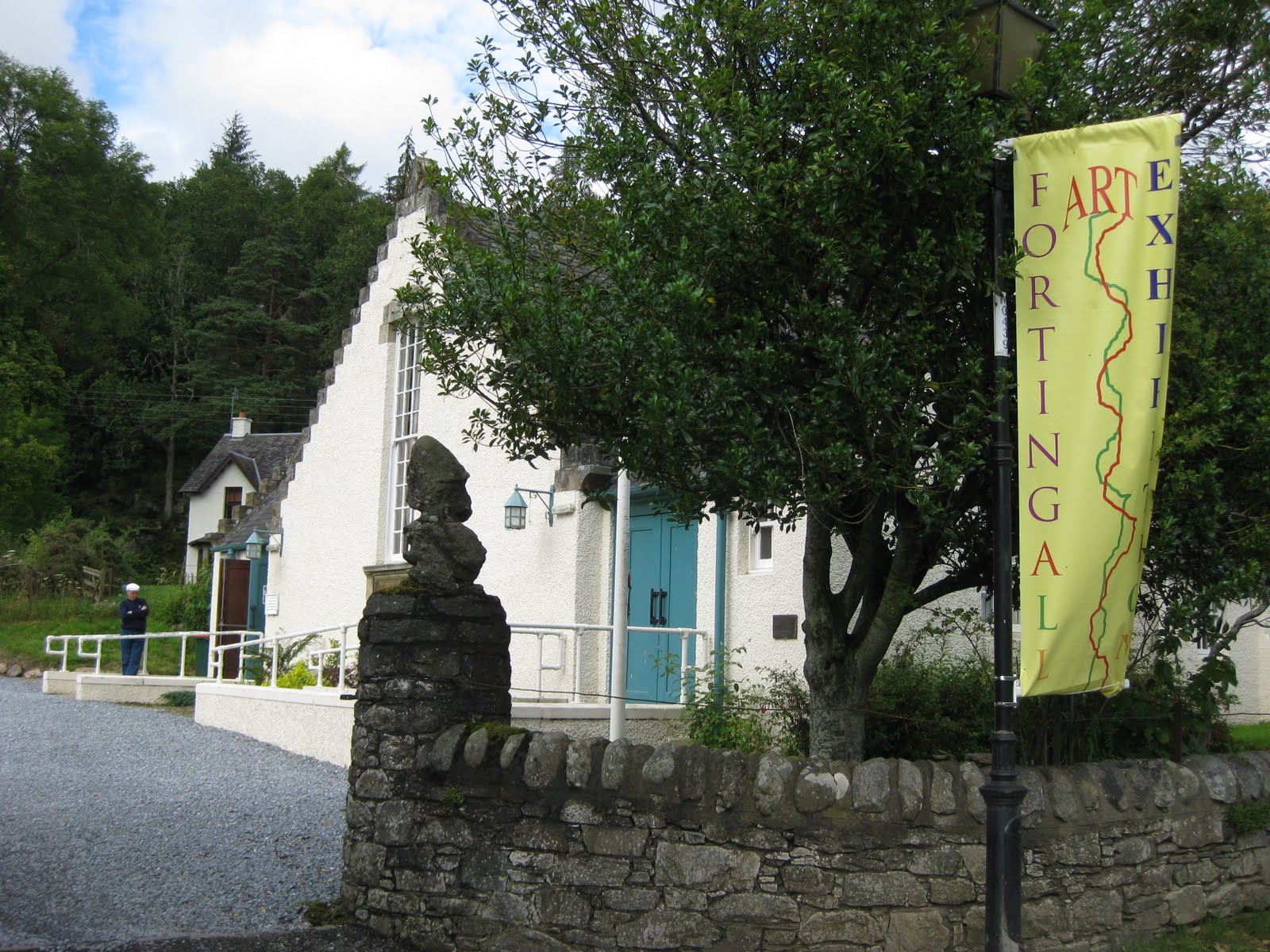 Fortingall Art is well under way since the opening on Friday night. I was on duty yesterday afternoon and expected a quiet few hours with an occasional chat as people drifted steadily in. Instead at times it was a frenzy of wrapping, receipt writing and taking money. We had over a hundred visitors to the Molteno Hall, despite its location in a very quiet village some distance from anywhere much, and they were spending too. It was good to see, if a little bemusing, where do they all come from?


The Splinter Group wood engravings were a quiet contrast with the paintings in rest of the hall. The book was printed in time, just and alphabet was almost complete (apart from X, which is extinct). Our wee images take some looking at, but they make a satisfying and intriguing tile effect when they’re all together and the book is very beautiful and reflects not just the diversity of the Scottish fauna but also of the members of the Splinter Group. I suspect it needs to be handled to be fully appreciated, but there’s been lots of interest in the prints. Philippa Swann produced some lovely booklets explaining who the Splinter Group is and a little about the processes of wood engraving and printmaking. I think it’s quite difficult to convey how much work and skill is involved in traditional printmaking in these days of computers and laser jets so we need to put some effort into explanation. The exhibition finishes on Sunday, and then it’s onto the Splinter Group’s next project.
